
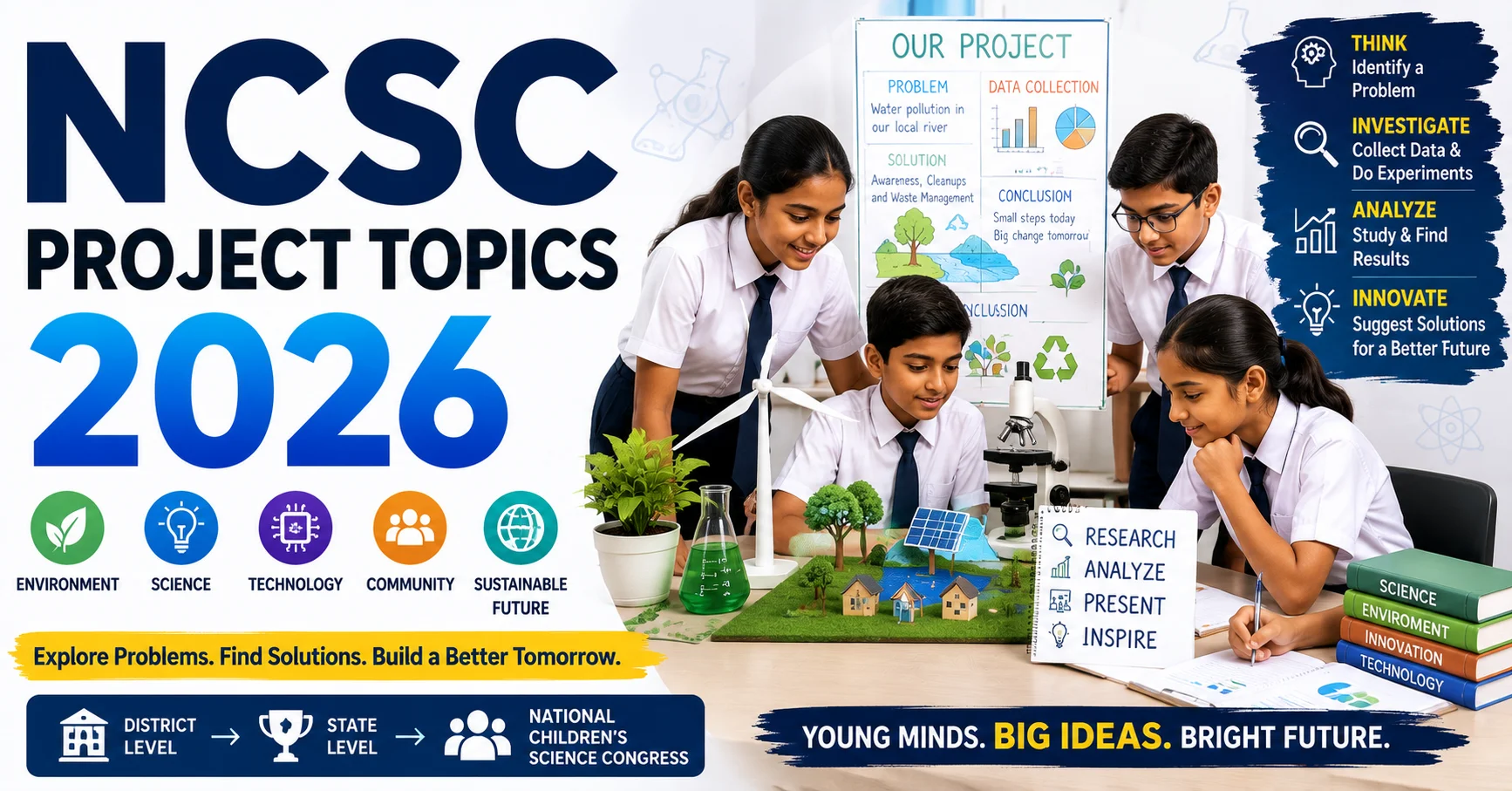
The National Children’s Science Congress (NCSC) is India’s biggest platform for young researchers aged 10–17 to turn everyday curiosity into real scientific inquiry. Every year, lakhs of students pick a local problem, study it using the scientific method, and present their findings — first at the district level, then state, and finally at the national stage.
This guide answers the most common questions students, teachers, and parents search for around NCSC — the 2026 cycle, the theme, registration, and a continuously numbered list of 250+ NCSC project topics across every major category.
Must Read: 241+ Unique Ofrenda Project Ideas For School Students
What Is an NCSC Project? (Quick Answer)
An NCSC project is a group research activity — usually done by 2 to 5 students under a guide teacher — where children study a local science, environment, or technology-related problem connected to that year’s official focal theme. They collect data, run small experiments or surveys, analyse the results, and present their findings and solutions through a report and exhibit at the District, State, and National Children’s Science Congress events.
National Children’s Science Congress (NCSC): Key Facts
NCSC has been organised every year since 1993 by the National Council for Science and Technology Communication (NCSTC), under the Department of Science and Technology (DST), Government of India, along with state-level science councils and district coordinators.
- Who can participate: Students aged 10–17, whether in school or outside the formal school system
- Group size: Typically 2–5 children per project, supervised by a guide
- Levels: District → State → National Children’s Science Congress
- International participation: Recent editions have hosted delegates from countries like Bahrain, the UAE, Kuwait, Oman, and Saudi Arabia
NCSC 2025–26 Theme and Sub-Themes
The 31st National Children’s Science Congress was held with the focal theme “Understanding Ecosystem for Health and Well-Being”, exploring how ecosystems around us directly support human health and nutrition. It was organised around five broad sub-themes covering ecosystem understanding, health and nutrition, self-sufficiency through eco-friendly methods, useful technology and innovation, and social-cultural practices.
The National Children Science Congress 2026 cycle (32nd edition) follows the same district-to-national structure. Since DST announces the official focal theme and exact national event dates separately each year, students should confirm the current-year theme and NCSC 2026 registration dates with their District/State NCSC Coordinator or the official NCSC web portal before finalising a project.
NCSC Registration Process
- Contact your school science teacher or your District Coordinator to register your group.
- Register your team on the official NCSC web portal once district-level registration opens.
- Select a topic connected to the current year’s focal theme and sub-themes.
- Submit your project at the district-level NCSC / science exhibition first — winning entries move up to state and then national level.
250+ NCSC Project Topics
Use this list as a starting point — the strongest NCSC entries take one of these ideas and narrow it down to a real, local problem in the student’s own neighbourhood, school, or village.
A. Environmental Science Project Topics
- Test and map groundwater quality across wells in your village or ward.
- Study how street lighting affects the sleep cycles of local birds and insects.
- Build a low-cost dust-collector to measure roadside particulate pollution near your school.
- Compare plastic waste generated by three local markets and design a reduction plan.
- Investigate why a specific local pond, lake, or stream is shrinking or drying up.
- Study the effect of vehicle idling outside school gates on local air quality.
- Track how illegal sand mining affects a nearby riverbank.
- Design a low-cost noise barrier for a school located near a busy road.
- Analyse how paddy stubble burning in your district affects nearby air quality.
- Study how a local landfill or dumping site is affecting groundwater in the area.
- Investigate the survival rate of saplings planted under a local afforestation drive.
- Map heat-island zones within your town using simple temperature readings.
- Study how brick kilns in your area affect crop yield in nearby fields.
- Design a community e-waste collection and safe-disposal system.
- Investigate the link between open drains and mosquito breeding in your locality.
- Study how monsoon flooding patterns have changed in your area over the last decade.
- Analyse packaging waste from a local sweet shop or dhaba and propose alternatives.
- Study how a nearby quarry or mining site is affecting local vegetation.
- Design a low-cost model to reduce dust pollution at a construction site.
- Investigate whether traditional water-harvesting structures (johads, baolis, tanks) in your area still function, and why or why not.
B. Health and Medicine Project Topics
- Survey iron-deficiency anaemia rates among adolescent girls in your school.
- Study handwashing habits in your school and their link to absenteeism.
- Investigate the nutritional gap between mid-day meals and recommended diets.
- Study screen-time patterns among classmates and their effect on eye strain.
- Survey local awareness of ORS and its use during diarrhoea in young children.
- Investigate why a particular waterborne disease recurs seasonally in your area.
- Study posture-related back pain among students carrying heavy school bags.
- Analyse the accuracy of home remedies commonly used in your community for fever.
- Survey vaccination coverage and gaps among children under five in your locality.
- Study the effect of noise pollution near a hospital on patient recovery reports.
- Investigate first-aid knowledge gaps among teachers and students in your school.
- Study dietary patterns linked to childhood obesity in your area.
- Survey menstrual hygiene awareness and access to sanitary products among peers.
- Investigate local dependence on antibiotics without prescription and its risks.
- Study the relationship between indoor cooking smoke and respiratory illness in homes using firewood or coal.
- Analyse dental health habits and cavity rates among primary school children.
- Survey stress levels among senior secondary students during exam season.
- Study the accessibility of the nearest Primary Health Centre for your village.
- Investigate local elders’ knowledge of traditional medicinal plants and verify one claim scientifically.
- Study sleep duration and academic performance among your classmates.
C. Technology and Innovation Project Topics
- Build a low-cost soil-moisture sensor using basic electronic components.
- Design an Arduino-based early flood-warning alert for a low-lying area.
- Create a simple app or website listing government scholarships available in your district.
- Build a solar-powered mobile charging station for a village with unreliable electricity.
- Design an automatic street-light system that turns on only when needed.
- Build a low-cost water-level indicator for household overhead tanks.
- Create a QR-code based system to track medicine expiry at a local pharmacy.
- Design a simple obstacle-detecting cane prototype for visually impaired users.
- Build a low-cost seismic vibration sensor to detect structural stress in old buildings.
- Create a chatbot or FAQ tool answering common exam-related queries for students.
- Design a rainwater-collection alert system using a simple sensor and buzzer.
- Build a model smart-irrigation controller that responds to soil-moisture readings.
- Create a low-cost air-quality display board for your school entrance.
- Design a biometric or app-based attendance system for a small classroom.
- Build a simple wind-speed measuring device (anemometer) from local materials.
- Create a mobile app prototype to report potholes or broken streetlights to the local municipality.
- Design a low-cost baby-incubator temperature alert for rural health centres.
- Build a model automatic waste-segregation bin using simple sensors.
- Create a digital literacy tutorial series for elderly residents in your community.
- Design a low-power Wi-Fi based intercom for a school with weak mobile network.
D. Social Sciences and Humanities Project Topics
- Survey why girls in your area drop out of school after Class 8 or 10.
- Study how child marriage rates have changed in your district over ten years.
- Investigate local awareness of the RTI Act and how often it is used.
- Study the effect of migration for work on children left behind in your village.
- Survey local attitudes toward inter-caste marriage among two generations.
- Investigate access to public toilets for women in your local market or bus stand.
- Study how self-help groups have changed household income for local women.
- Survey students’ understanding of their constitutional rights and duties.
- Investigate the working conditions of local daily-wage or gig workers.
- Study how a local festival or tradition has changed over the last 20 years.
- Survey awareness of cyberbullying and online safety among your classmates.
- Investigate barriers faced by first-generation learners in higher education.
- Study the impact of a local government scheme (like PMAY or Ayushman Bharat) on beneficiary families.
- Survey local youth opinions on career choices versus family expectations.
- Investigate accessibility of public spaces and transport for persons with disabilities in your town.
- Study how joint families versus nuclear families affect elder care in your community.
- Survey local knowledge of consumer rights and grievance redressal.
- Investigate how a local language or dialect is losing everyday use among youth.
- Study voter awareness and turnout patterns among first-time voters in your area.
- Survey how social media influences body image among teenagers in your school.
E. Agriculture and Food Science Project Topics
- Compare crop yield between farmers using organic versus chemical fertilisers in your village.
- Study post-harvest losses of a local seasonal crop and their causes.
- Investigate the shelf life of a local staple food using different storage methods.
- Design a low-cost cold-storage model for perishable vegetables.
- Study how drip irrigation adoption has changed water use among local farmers.
- Investigate pesticide residue awareness among vegetable vendors in your local market.
- Study the effect of intercropping on pest control in a local field.
- Design a low-cost seed-germination testing kit for farmers.
- Investigate why a traditional local crop variety is being replaced by hybrid seeds.
- Study soil fertility differences between a chemically farmed and an organically farmed field nearby.
- Design a low-cost solar dryer for fruits or vegetables.
- Investigate the economics of a local Farmer Producer Organisation (FPO).
- Study how monsoon delay affects sowing decisions among farmers in your district.
- Analyse the nutritional value of a traditional local recipe versus a processed alternative.
- Investigate the effect of mulching on soil moisture retention in a home garden.
- Study beekeeping’s impact on fruit yield in a nearby orchard.
- Design a low-cost vermicompost unit using kitchen waste.
- Investigate access to Minimum Support Price (MSP) benefits among small farmers in your area.
- Study fish farming (pisciculture) practices and water quality in a local pond.
- Analyse food safety practices at street-food stalls near your school.
F. NCSC Project Topics for Class 9 Students
- Test drinking water samples from three sources in your locality for basic contamination.
- Build a working model of a solar water heater using recycled materials.
- Study waste segregation practices in your school and propose improvements.
- Design a poster-based awareness campaign on reducing plastic straws in your area.
- Build a simple model showing how a biogas plant converts kitchen waste to fuel.
- Investigate why a local government school has low science-lab usage.
- Study the effect of shade-net covering on plant growth in your kitchen garden.
- Build a rain gauge and record rainfall data for your area over a month.
- Design a low-cost compost bin suitable for an apartment balcony.
- Study how much water is wasted by a leaking tap and calculate the yearly loss.
- Build a working model of a wind turbine using cardboard and a small motor.
- Investigate local recycling rates for glass, paper, and metal.
- Study the germination rate of seeds soaked in different types of water (RO, tap, rain).
- Design an awareness campaign on reducing food wastage in school canteens.
- Build a model showing how a septic tank treats household wastewater.
- Study the temperature difference between a shaded and an unshaded schoolyard.
- Investigate how many households in your street use LED versus older bulbs, and the energy saved.
- Build a simple periscope or solar oven as a working science model.
- Study which local trees survive best during summer water shortages.
- Design a comic strip or short film explaining a science concept to younger children.
- Build a working model of an artificial recharge pit for groundwater.
- Investigate air quality differences between your classroom with and without ventilation.
- Study how effective a school’s dustbin placement is in reducing litter.
- Design a low-cost model for segregating wet and dry waste at home.
- Build a model showing the working of a simple water filter using sand, charcoal, and gravel.
- Study how much paper your school uses in a month and propose a reduction plan.
- Investigate why certain plants grow better in your school garden than others.
- Build a working model of a hydraulic lift using syringes and tubing.
- Study the effect of different soil types on water retention using simple pots.
- Design an awareness pamphlet on saving electricity at home.
- Build a model earthquake-resistant structure using ice-cream sticks.
- Study how shadow length changes through the day and what it teaches about the sun’s path.
- Investigate the effectiveness of a homemade natural pesticide on garden pests.
- Build a working model demonstrating the greenhouse effect using two bottles.
- Study which fruits or vegetables in your local market are grown closest to your town.
- Design a low-cost model of a solar cooker and test its efficiency.
- Investigate noise levels at different times of day near your school.
- Build a working model of a simple water wheel to generate small-scale power.
- Study how well your school’s rainwater harvesting system (if any) is functioning.
- Design an awareness activity on the dangers of bursting firecrackers near hospitals.
- Build a model volcano to explain a real local geological feature, if any.
- Study how effective cloth masks versus surgical masks are at filtering dust in a simple test.
- Investigate how street vendors near your school store food, and food-safety risks involved.
- Build a working model of traffic-light timing based on real traffic count data near your school.
- Study the effect of adding compost on plant growth compared to untreated soil.
- Design a low-cost model to demonstrate soil erosion and how tree roots prevent it.
- Investigate energy usage patterns of common home appliances using a simple wattmeter.
- Build a working model of a simple water-purification system for emergency use.
- Study how much water your school uses daily and identify wastage points.
- Design an awareness drive on safe disposal of used batteries in your locality.
G. NCSC Project Topics for Science Exhibitions
- Build a working model demonstrating capillary action and its role in plant water uptake.
- Study how different types of mulch affect soil temperature.
- Design a model explaining the water cycle using a sealed terrarium.
- Investigate the effect of magnetic fields on plant seed germination.
- Build a model demonstrating how a fire extinguisher works.
- Study bioindicator species (like lichens) to assess local air quality.
- Design a working model of a simple electric generator using a hand crank.
- Investigate how sound travels through different materials (air, water, solid).
- Build a model showing the process of desalination using simple distillation.
- Study the effect of different light colours on plant growth.
- Design a working model of a simple pH indicator using red cabbage extract.
- Investigate how effective different insulating materials are at retaining heat.
- Build a model explaining the phenomenon of eutrophication in ponds.
- Study how a simple solar still can purify saline or dirty water.
- Design a working model demonstrating Newton’s laws using a toy car.
- Investigate the corrosion rate of different metals in varying environments.
- Build a model explaining how a battery stores and releases chemical energy.
- Study the effect of temperature on the rate of a simple chemical reaction (like an antacid tablet dissolving).
- Design a working model of a simple hydraulic ram pump for lifting water.
- Investigate how effective different materials are as sound absorbers.
- Build a model explaining the working of a simple thermostat.
- Study the density and buoyancy differences between fresh water and salt water.
- Design a working model demonstrating the working of a simple pulley system.
- Investigate how plant transpiration rate changes with humidity.
- Build a model showing how earthquakes are detected using a simple seismograph.
- Study the effect of different fertiliser concentrations on plant growth.
- Design a working model of a simple periscope for indirect viewing.
- Investigate how UV exposure affects the germination rate of common seeds.
- Build a model demonstrating the greenhouse gas effect using two sealed containers.
- Study the effectiveness of different natural coagulants (like moringa seeds) in water purification.
- Design a working model explaining the principle of a simple electric motor.
- Investigate how salinity affects the boiling and freezing points of water.
- Build a model demonstrating the working of a simple barometer.
- Study how different types of soil affect the speed of water infiltration.
- Design a working model of a simple crane using pulleys and levers.
- Investigate the antibacterial properties of common household substances (like turmeric or honey) in a safe, supervised test.
- Build a model explaining the formation of acid rain and its effect on marble.
- Study the relationship between surface area and evaporation rate using different container shapes.
- Design a working model of a simple compass and explain magnetic declination.
- Investigate how different types of packaging affect the shelf life of bread.
- Build a model demonstrating the working of a simple lever system for lifting heavy loads.
- Study how much a simple insulated box can slow ice melting compared to an open container.
- Design a working model explaining the Doppler effect using a rotating sound source.
- Investigate the effect of different watering schedules on plant health.
- Build a model demonstrating the working of a hydraulic brake system.
- Study the germination difference between treated and untreated (chemically coated) seeds.
- Design a working model showing convection currents using coloured water.
- Investigate how different soil pH levels affect the growth of a common vegetable.
- Build a model explaining the working of a simple rainwater filtration column.
- Study how effective a homemade natural repellent is against common household pests.
H. NCSC Project Topics on “Know Your Ecosystem”
- Map and study the biodiversity found within a 500-metre radius of your school.
- Study how construction of a new building has changed bird activity in your area.
- Start a citizen-science project testing water quality of a local stream monthly.
- Study which pollinators are most active in your school or home garden.
- Create a photo-documented guide to ten common plants growing near your home.
- Research how water hyacinth is affecting a local pond or lake.
- Design a restoration plan for a neglected patch of green space in your area.
- Study how soil compaction from footfall affects plant growth in a local park.
- Start a peer-education program teaching younger students about your local ecosystem.
- Study how a nearby coastal, riverine, or hill ecosystem has changed due to tourism.
- Create a model of a closed food system connecting a local farm, market, and household.
- Explore how rooftop or balcony beekeeping could work in your urban area.
- Start a monthly count of a locally at-risk bird, insect, or plant species.
- Study how the tree cover in your neighbourhood affects afternoon temperatures.
- Create a field guide to the medicinal or culinary uses of plants growing wild near you.
- Study how rainwater runoff from paved roads is affecting a nearby drain or stream.
- Design a habitat-restoration plan for a degraded patch of common land.
- Research how a community composting pit has changed local soil quality over time.
- Study how a nearby wetland reduces flooding risk for surrounding homes.
- Create a short documentary or photo-essay on a local ecosystem under threat.
- Study how construction near a wetland or lake has changed migratory bird visits.
- Start a citizen-science project mapping tree species in your neighbourhood.
- Explore how a rooftop garden changes insect diversity compared to a bare rooftop.
- Design a wildlife-crossing or corridor proposal for a road that cuts through green space.
- Study how much urban trees reduce noise levels along a busy street.
- Create a guide documenting traditional uses of ten plants known to your grandparents’ generation.
- Study how foot traffic and picnicking affect plant cover in a popular local park.
- Start a stream or drain clean-up and document the change in water clarity over weeks.
- Explore how a restored patch of wetland has changed local frog or insect populations.
- Design a rainwater-management plan for a locality that floods every monsoon.
- Study whether access to a nearby green space correlates with reported stress levels among residents.
- Create a guide explaining the function of each layer in a nearby forest or scrubland ecosystem.
- Study how a specific local animal or plant species has responded to recent weather changes.
- Start a citizen-science project logging tree health in your school or colony.
- Explore how urban farming on unused plots is affecting local food access.
- Design a proposal for a small wildlife sanctuary or safe zone within your town.
- Study how green cover in your ward compares to a neighbouring, more built-up ward.
- Create a guide to a local festival’s traditional connection to nature or harvest cycles.
- Study how an invasive plant species is outcompeting native vegetation in a nearby field.
- Start a program restoring native plants to a neglected traffic island or roundabout.
- Explore how beekeeping near an orchard has changed local fruit-set percentages.
- Design a simple code of conduct to reduce human disturbance in a local nesting site.
- Study how a nearby urban forest patch improves air quality compared to open ground.
- Create a virtual or physical nature trail highlighting five ecological features near your school.
- Study how construction debris dumping has changed the ecology of a vacant lot.
- Start a citizen-science project tracking water levels in a local stream through the seasons.
- Explore how composting waste from a local vegetable market improves nearby soil.
- Design a wildlife-corridor map connecting green patches across your neighbourhood.
- Study how a local wetland’s water level affects the frequency of flooding downstream.
- Design a low-cost sensor network to track temperature and humidity across your ecosystem site in real time.
Benefits of Doing an NCSC Project
- Scientific thinking: Builds critical thinking and scientific inquiry skills.
- Hands-on learning: Gives practical experience in doing research.
- Problem-solving: Encourages students to solve real-world issues creatively.
- Environmental awareness: Deepens understanding of local environmental problems.
- Communication skills: Improves the ability to present ideas and results.
- Teamwork: Builds collaboration skills through group projects.
- Self-confidence: Boosts self-esteem through achievement and recognition.
- Networking: Connects students with peers and experts nationwide.
- Career exploration: Introduces possible careers in science and technology.
- Community impact: Lets students improve their own communities through real solutions.
How to Write a Winning NCSC Project (Step-by-Step)
- Choose a topic: Pick a local issue related to science, technology, or the environment that genuinely affects your community.
- Set clear goals: Define what you want to learn or achieve.
- Do background research: Gather information from reliable, credible sources.
- Plan your method: Build a step-by-step plan for data collection and experiments.
- Collect and analyse data: Use surveys, experiments, and observations, then study the results.
- Draw conclusions: Interpret your results against your original goals.
- Propose solutions: Suggest practical ways to address the problem you studied.
- Document your process: Keep detailed notes of your idea, methods, data, and results.
- Build a strong presentation: Make it clear, visual, and concise for judges.
- Practice explaining it: Be ready to answer questions confidently about every part of your project.
NCSC Project Topics: FAQs
What is the NCSC?
The National Children’s Science Congress (NCSC) is an annual science communication programme for students aged 10–17, run since 1993 by the NCSTC under India’s Department of Science and Technology.
Who can take part in NCSC?
Any child aged 10 to 17, whether enrolled in a formal school or not, can participate as part of a small group (usually 2–5 members) under a guide.
What is the NCSC 2026 theme?
The official focal theme and sub-themes for each NCSC cycle are announced separately by DST/NCSTC. The most recent confirmed theme (31st NCSC) was “Understanding Ecosystem for Health and Well-Being” — students should check with their District/State Coordinator or the official NCSC portal for the current cycle’s confirmed theme.
How does NCSC judging work?
Projects move through three stages — District, State, and National — with the strongest entries at each stage selected to progress to the next level.
Can one student submit an NCSC project alone?
NCSC projects are designed as group activities, typically involving 2 to 5 children working together under a guide teacher or mentor.
Where do I register for NCSC?
Registration happens through your school or District Coordinator, followed by confirmation on the official NCSC web portal once district-level registration opens for the year.
Also Read: Amazing 499+ AI Project Ideas for Students 2024
Wrap Up
NCSC project topics give young scientists a real reason to observe, question, and experiment. Working through one of these 250+ ideas — refined into a specific, local problem — teaches students to think like researchers, build confidence, and discover solutions with genuine community impact. Whether a child dreams of becoming a scientist or simply loves asking “why,” an NCSC project is where that curiosity turns into real-world learning. Today’s small district-level project could well be the seed of tomorrow’s big scientific idea.